.png)
MAD//Fest: The Human touch
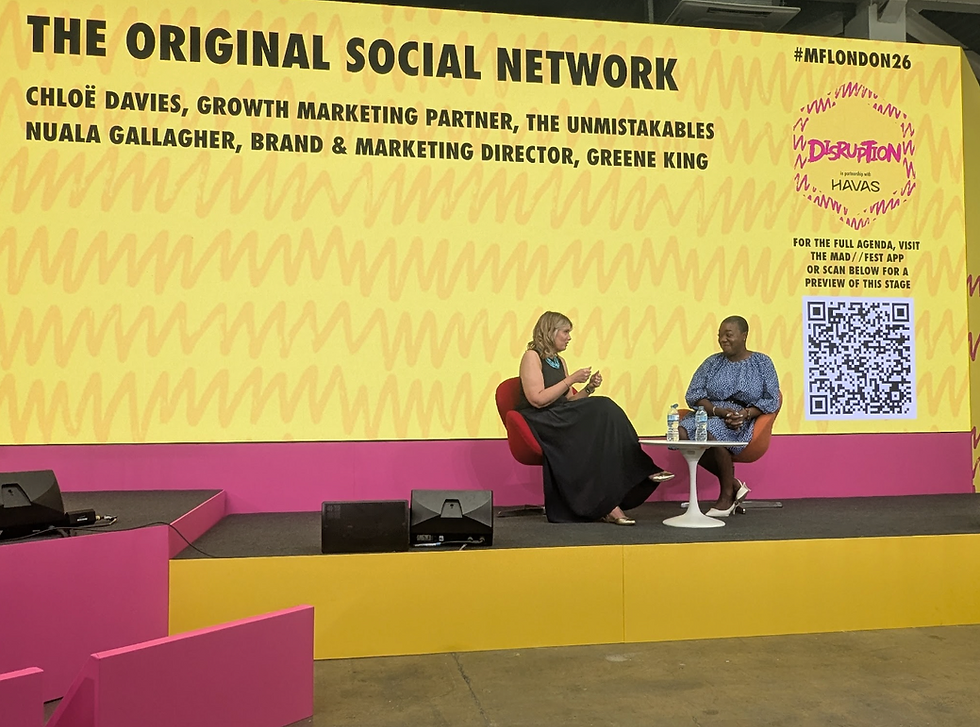
If there was one phrase that echoed around MAD//Fest this week, it was The Human Touch.
It wasn't just the festival's theme. It was the thread connecting conversations about AI, behavioural science, creativity, customer experience and leadership. In an industry captivated by what technology can do, the biggest question wasn't whether AI will change marketing - it already has. The question was what becomes more valuable because of it.
That was certainly the conversation Nuala Gallagher from Greene King and I found ourselves having on stage as we explored The Original Social Network.
When we think about social networks today, our minds instinctively jump to platforms, feeds and algorithms. But long before any of those existed, communities gathered somewhere else. They met in pubs to celebrate milestones, mourn loved ones, watch sport, debate politics, make friends and simply spend time together. These weren't just places to eat and drink; they were places where relationships were built and communities found a sense of belonging.
Perhaps that's why this conversation felt so personal. My relationship with hospitality started long before my career in marketing. I've been cooking since I was three years old, later working in professional hospitality, including silver service at the Saatchi Gallery. I have spent years delivering live events and eventually built my own catering company.
Looking back, it's clear that hospitality taught me some of the most important lessons of my career. It teaches you to pay attention. To notice who feels included and who doesn't. To anticipate needs before they're voiced and to understand that every interaction contributes to how someone feels about an experience.
That understanding was reinforced at the very start of our session. I asked the audience a simple question: "How many of you have been to a pub in the last week?" Around 80% of the room put their hands up.
For a room full of marketers, strategists and business leaders, it was a powerful reminder. Despite all the advances in technology and the countless ways we can now connect digitally, people are still choosing to gather in physical spaces. We still seek places to celebrate, reflect, reconnect, watch sport, solve problems and simply spend time together.
As Nuala so brilliantly put it during our conversation:
"The pub is the social glue, cradle to grave, that keeps the community together and acts as a social leveller. You're all together, being hosted. And it's uniquely British in its role in society."
It was wonderful to see that quote singled out afterwards as one of the highlights of the day. Not because it was about pubs, but because it articulated something our industry is beginning to rediscover: the brands we remember aren't simply the ones with the smartest technology. They're the ones that understand people.
Connection.
Belonging.
Hospitality.
These aren't new concepts. Yet they may be becoming more important than ever.
Our conversation wasn't about resisting innovation. In fact, the opposite is true. Technology has transformed hospitality in remarkable ways, from reducing friction to creating more seamless customer experiences. The opportunity isn't to choose between technology and humanity, but to ensure the former always strengthens the latter.
That sentiment surfaced repeatedly throughout the festival. Whether speakers were discussing AI, creativity or customer experience, there was a shared recognition that technology alone isn't a strategy. It's an enabler. The organisations creating the greatest impact are using it to remove friction, unlock insight and accelerate creativity, whilst remaining deeply focused on the people they serve.
In many ways, that was the hidden lesson of MAD//Fest. Whilst the conversations were filled with examples of the latest technology and the newest tools, the ideas that lingered were remarkably familiar. They centred on trust, belonging, creativity, curiosity and empathy. In other words, the qualities that have always shaped meaningful relationships between brands and people.
As marketers, we've become incredibly good at measuring behaviour. We know where people click, how long they stay, what they purchase and when they leave. We have dashboards that update in real time and models that predict future behaviour with astonishing accuracy.
Yet many of the things that truly shape customer loyalty remain difficult to measure.
The feeling of being welcomed.
The confidence of feeling understood.
The comfort of familiarity.
The joy of sharing an experience with people you care about.
These moments rarely appear in a spreadsheet, but they often become the stories people tell long after the transaction has ended. They are the difference between a customer and an advocate, between a purchase and a relationship.
Marketing often talks about customer centricity, but hospitality has been practising it for generations. It starts with a simple question: how do we make people feel welcome? Everything else follows.
At The Unmistakables, we talk about organisational lag: the gap between how organisations think society works and how it actually does. The more I listened throughout the festival, the more I was reminded that reducing that gap isn't simply about collecting more data or building more sophisticated technology. It's about ensuring that every decision is rooted in a genuine understanding of people.
Technology can tell us what customers are doing. It can identify patterns, optimise journeys and personalise experiences at scale. But understanding why people behave the way they do -and what truly matters to them- still requires curiosity, empathy and human insight.
That's where relevance lives.
Not in adopting every new capability because it's available, but in understanding how those capabilities help us create products, services and experiences that people genuinely value. Organisations don't become more relevant because they use AI. They become more relevant because they use it in ways that deepen relationships, solve meaningful problems and create better outcomes for customers, colleagues and communities alike.
Hospitality has understood this instinctively for generations. Great pubs don't simply serve food and drink. They create spaces where people gather after difficult days, celebrate life's biggest milestones, reconnect with old friends and welcome new faces. Greene King's community initiatives and cultural partnerships are an extension of that philosophy. They're not simply campaigns; they're an expression of the role the business wants to play in people's lives.
Perhaps that's why The Human Touch felt like such an appropriate theme for this year's MAD//Fest. In a world where technology is becoming increasingly accessible, humanity is becoming increasingly distinctive.
The future of marketing won't be built by choosing between people and technology. It will be built by combining the strengths of both.
Because the original social network was never built on algorithms.
It was built on people.