Soul Over Scroll
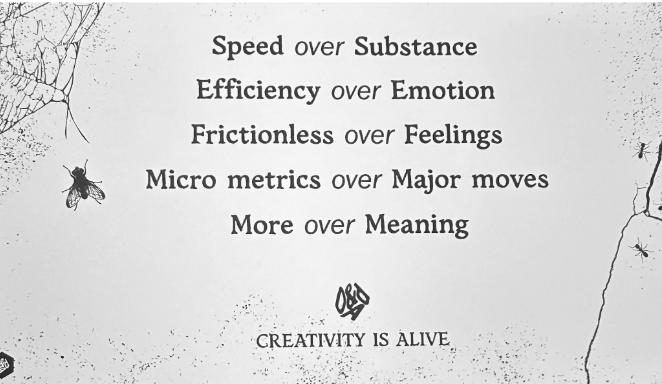
Across two consecutive days last week, first at Campaign Media360 and then at D&AD’s Creative Impact Accelerator, there was a quiet but consistent tension running underneath almost every conversation.
On the surface, the topics varied. AI. Effectiveness. Attention. Trust. Creativity. Performance. Platforms. Audience fragmentation.
But beneath all of it sat a much bigger question about how organisations, leaders and creative industries continue to evolve whilst the ground beneath them is shifting in real time.
Campaign Media360, in particular, felt like an industry trying to make sense of acceleration.
Audience behaviour is changing faster than planning cycles can keep up with. AI is reshaping production, search and discovery in real time. Brand loyalty feels more conditional. Performance marketing is delivering diminishing returns in some areas whilst cultural relevance increasingly depends on speed, adaptability and emotional resonance rather than simply scale.
And yet, despite the volume of conversation around automation and optimisation, many of the sessions that felt most future-facing were actually the ones pulling the industry back towards something more human.
Kate Mellett from Snapchat captured this tension particularly well during her session on “Authentic Intelligence”. Rather than framing AI purely as a production tool, she spoke about technology through the lens of relationships, intimacy and emotional connection.
One line especially captured the mood of the wider week:
“When you prioritise the scroll over the soul, you lose everything that makes social media social in the first place.”
It was a sharp observation, but also a revealing one. Because increasingly, businesses themselves are navigating the same challenge internally: how to move faster without hollowing themselves out in the process.
That tension surfaced repeatedly throughout Campaign Media360.
The Talent Equation session was one of the clearest examples of this. Grace Dent spoke honestly about creativity being frowned upon growing up, finding her voice later and relentlessly pitching until people finally paid attention. The more significant point sat underneath the conversation around talent itself: most people who go on to create meaningful work also encounter specific individuals who recognise something in them before the wider world does.
There was also a powerful conversation around what was described as “talent dissipation” - businesses hiring people for their originality, perspective and difference, only to slowly sand those edges down through hierarchy, process and brand safety.
That idea connected directly to a wider organisational tension emerging right now. Many businesses claim to want innovation whilst simultaneously creating cultures that struggle to tolerate the discomfort innovation requires.
The conversation around AI reflected something similar. Nobody was arguing against the technology itself. In fact, most speakers acknowledged the enormous opportunity AI presents. But one idea continued to resurface throughout the day: whilst AI can accelerate output, differentiation will increasingly come from the things that remain deeply human - perspective, emotional intelligence, craft, nuance and originality.
That same theme surfaced again during discussions around the future of brand meaning in AI. Several speakers pointed towards a future where brands are no longer communicating solely with humans, but increasingly with algorithms and AI systems shaping discovery, recommendation and search behaviour.
What becomes visible.
What gets surfaced.
What gets trusted.
What gets remembered.
Search itself is becoming more conversational, which means brands are no longer just shaping perception, they are increasingly shaping the very questions people ask.
And despite all the technological acceleration, human craft kept reappearing as the differentiator.
Not anti-AI but very clearly anti-generic.
Even Samsung Ads’ conversations around sport, cultural moments and live attention reflected this broader shift. Lauren Barnett from Samsung Ads discussed the growing importance of emotional relevance and collective cultural participation, including the unique role moments like the London Marathon still play in creating shared attention at scale.
As the London Marathon is one of our clients at The Unmistakables, the conversation resonated particularly strongly. Just last month, I stood at the finish line in the heart of the race, proudly waiting for Asad to complete his marathon whilst witnessing firsthand the emotional power that these collective moments still hold. In an increasingly fragmented landscape, live events continue to create something algorithms still struggle to replicate fully: shared emotional experience in real time.
What brands are increasingly searching for is not simply visibility, but belonging.
That idea connected strongly with the Sky Media, American Express and Netball Super League session featuring Enyi Nwosu, Dave Edwards and Karin Seymour. The conversation repeatedly returned to collaboration, community and creating genuinely rewarding fan experiences rather than simply transactional sponsorship mechanics. The Amex Super Shot and Super Shot Fund were discussed not just as a campaign, but as a way of creating meaningful value for athletes, fans and the wider netball community simultaneously.
As someone who played netball throughout school, captained the team and spent two years as part of a West London championship-winning side, there was something particularly resonant in hearing the conversation framed not simply around visibility for women’s sport, but around investment, participation and long-term community impact.
Again, the more interesting observation was not simply the activation itself, but the emphasis on co-creation and shared ownership. Not a rigid process. Not siloed thinking, but multiple partners building something iteratively together.
Then the following day at D&AD’s Creative Impact Accelerator, the conversation seemed to deepen. If Campaign Media360 focused on the external pressures reshaping the industry, D&AD focused far more on the internal conditions required for creativity, resilience and originality to survive inside those pressures.
During his opening remarks, D&AD Director Paul Drake made a comment that quietly framed much of the day that followed: “Creativity isn’t failing, the systems around it are.”
That observation set the tone for the wider conversations across the day. Orlando Wood explored the role of artistry, emotional resonance and enduring creativity in an increasingly fragmented attention economy, whilst later Charlotte Williams hosted the CMO panel featuring Katie Evans from Burger King and Tanya Grubner from Essity.
What emerged repeatedly throughout the sessions was the idea that many organisations have quietly spent years optimising themselves into creative caution. The pursuit of speed, certainty and measurable outputs has often come at the expense of experimentation, emotional resonance and original thinking. We have become incredibly good at reducing risk whilst simultaneously wondering why so much work feels forgettable.
The irony, of course, is that the campaigns, brands and ideas people continue to emotionally connect with rarely emerge from rigid systems. They tend to come from tension, instinct, collaboration and a willingness to tolerate uncertainty long enough for something meaningful to emerge.
You could hear that repeatedly during the CMO panel discussions around emotional truths, long-standing agency relationships and environments where unfinished thinking can still be shared safely.
Katie Evans described the importance of agencies being able to bring “nuggets” rather than “fully baked ideas”, creating space for collaborative evolution instead of over-polished certainty from the outset.
That comment reveals something important about the relationship between resilience and creativity. Organisations that only reward certainty eventually create cultures where people stop experimenting publicly. Ideas become overly refined before they are shared. Creative risks get softened. Instinct becomes secondary to consensus.
Eventually, the work may become efficient, but it also becomes emotionally flat.
At The Unmistakables we often talk about relevance not as visibility, but as the ability to create meaningful connection within culture, communities and lived human experience. Sitting across both days of conversations, it became increasingly clear that this distinction is becoming more important, not less. Particularly in a landscape where generic content is becoming easier to produce at scale.
The week’s most valuable insight was probably not strategic at all.
It came during The Talent Equation session, when Grace Dent spoke about setbacks, rejection and creative resilience with far less performance than the industry often attaches to those conversations.
Get your ducks in a row.
Lick your wounds.
Self validate.
Regroup.
Return.
Simple, unspectacular but probably closer to the reality of meaningful growth than most leadership language allows.
Because beneath all the conversations around AI, effectiveness, attention and transformation sat a more uncomfortable truth: most organisations are still trying to figure out how to evolve without losing themselves in the process and perhaps that is why “work in progress” feels like such an important phrase right now.
Not because people lack capability but because the conditions around all of us are changing faster than certainty can stabilise.
The strongest leaders, brands and creative cultures are unlikely to be the ones pretending to have everything resolved.
They will be the ones capable of staying open, adaptive and emotionally intact whilst building through uncertainty.
Not finished.
Not fixed.
Still becoming.